AI for sales forecasting trains a model on your past CRM deals and activity, then scores each open deal’s win probability. The scores roll up into a forecast for the period. The catch: it needs clean CRM fields and enough closed deals, and below that a weighted pipeline does the same job.
Below you get a worked accuracy test, a readiness table by deal volume and a vendor-neutral tools table with list prices. We sell no forecasting tool.
What Is AI for Sales Forecasting?
AI sales forecasting is a method where a model learns from your closed deals which signals went with wins, then applies them to open deals. Each open deal gets a win probability, and the probabilities roll up into a forecast for the period.
AI powered sales forecasting reads three kinds of input:
- CRM deal history: stage changes, amounts and close dates.
- Rep and buyer activity: emails, calls and meetings logged against the deal.
- Engagement signals from connected tools.
It returns two outputs:
- A win probability for each open deal.
- A forecast for the period built from those probabilities.
In Microsoft’s Dynamics 365 Sales, the period prediction is split into closed won, predicted from open opportunities and predicted from new opportunities.
Sales forecasting AI is the umbrella term: rule-based means fixed stage probabilities set in the CRM, and machine learning means probabilities learned from outcomes.
How AI in Sales Forecasting Works
AI in sales forecasting reads closed deals, learns which patterns ended in wins, scores open deals and leaves a manager to review the number.
- Data in: the model takes closed and open deals from the CRM.
- Pattern finding: it learns what past wins had in common. HubSpot’s AI projections, for example, learn from closed-won deals of the past three months.
- Output: the AI sales prediction arrives per deal and per period. HubSpot returns a lower, most likely and upper range.
- Human review: vendors present the output as an estimate. A manager holds context the CRM does not, such as buyer commitments made by phone or a champion who left.
A model can return two probabilities: a deal is won, and it closes in a given period. Take a 60k deal at a 70% win probability, with a 60% chance of closing this quarter and 40% next. Our calculation books 25.2k this quarter and 16.8k next; a stage-style call books all 42.0k now.
What Data Does AI Forecasting Need?
AI forecasting has no neutral minimum of data; each vendor sets its own bar.
- Salesforce Einstein Forecasting wants opportunities worked in Salesforce for at least 12 months, with an update in each month. It also wants Amount filled on at least 80% of open opportunities.
- Salesforce Einstein Opportunity Scoring wants 200 closed-won and 200 closed-lost opportunities in 24 months.
- HubSpot’s AI projections learn from 3 months of closed-won deals.
The fields that matter are stage history, amount and close date, which the vendor docs name. Deal age and activity count are our judgment, not vendor requirements.
Three hygiene breaks each cause a specific failure, and HubSpot says projection accuracy depends on correct, current amounts and stages:
- Stale close dates teach the wrong period.
- Missing amounts shrink the roll-up.
- Skipped stages remove the learned path.
AI vs Traditional Sales Forecasting
AI vs traditional sales forecasting comes down to where the probability comes from. Traditional methods use rep judgment or one probability per stage; AI learns one per deal.
Misses are common. Xactly surveyed 405 North American sales and finance/RevOps professionals (Xactly, Jul 2024). In 2024, 80% said they had missed at least one forecast in the past year. Xactly sells forecasting software, so read it as a vendor survey.
| Rep call | Weighted pipeline | AI model | |
|---|---|---|---|
| What it uses | The rep’s judgment | Amount times stage probability | Closed-deal history plus activity |
| Who it favours | The optimistic or the cautious rep | Deals sitting in late stages | Deals that look like past wins |
| Where it breaks | Reps sandbag or hope | One probability per stage, whatever the deal | History is thin or the process changed |
| What it needs | Discipline | A clean stage definition | Closed deals and clean fields |
A five-deal pipeline of 340k is 174.0k stage-weighted and 130.5k model-weighted, a 43.5k gap. Two deals make up most of it. An 80k deal at 60% by stage and 35% by model accounts for 20.0k. A 60k deal at 40% by stage and 10% by model accounts for 18.0k.
the five-deal pipeline is our illustration.
The old method is still enough when you close few deals a quarter and the cycle is short. Sales forecasting using AI earns its place once you have the closed deals and clean fields the table’s last row asks for.
Takeaway: keep the weighted pipeline while it holds up against actuals and you close too few deals to feed a model.
Which Models Power AI Sales Forecasting?
No single AI model for sales forecasting wins; the fit depends on whether you forecast the period total or each deal. Machine learning for sales forecasting usually means one of five model families.
The first two columns follow Forecasting: Principles and Practice and the scikit-learn documentation; the last two are our judgment, not a vendor spec.
| Model family | What it predicts | Data it needs | Pick it when |
|---|---|---|---|
| Time series (exponential smoothing) | The period total, weighting recent periods more | A long, steady series of past periods | You forecast the total and history is steady |
| Regression | The forecast from predictors such as stage or activity | Enough closed deals per predictor | You can name the drivers and want to see them |
| Tree-based (gradient boosting) | Deal win from tabular fields | Hundreds of closed deals | You have clean CRM fields and volume |
| Neural networks | Patterns in large data; layers and nodes are set in advance | The most data, with the least explanation | You have large volume and accept a black box |
| Ensembles | A combined answer from several models | Whatever its member models need | One model is unstable across quarters |
Ask each vendor which family it uses and its error on unseen deals.
What AI Changes for Sales Teams
AI changes four things in a forecast review, and each comes with a limit.
- Deal risk flags: each open deal gets a score, and Aviso lists live opportunity scoring and deal risk mitigation in its forecasting core. Limit: it is only as good as the activity your team logs.
- Close-date accuracy: a deal won next quarter misses this quarter’s number. Limit: we found no recent independent figure for the gain, so treat it as a mechanism.
- Scenario ranges: HubSpot’s AI projection returns a range with a most likely midpoint instead of one number. Limit: it is in beta.
- Rep time on updates: Gartner reported in May 2026 that AI saves sellers 4.8 hours a week on average. In its survey of 210 sales leaders, 72% of sales organizations reinvest little of that time. Limit: this measures AI use in general, not forecasting.
How to Measure Whether AI Forecasting Is Accurate
To measure AI sales forecasting accuracy, compare each method’s forecast with actual bookings. Score both by MAPE and bias, over at least two quarters, against your own baseline.
*Forecasting: Principles and Practice* defines MAPE as the mean of the absolute percentage errors. Each percentage error is 100 times the error divided by the actual.
Bias is the average signed error, which shows whether you lean over or under. MAPE treats over and under forecasts asymmetrically, so read bias beside it.
Table 1 shows one team’s last four quarters of new-business bookings, in USD k. Error is forecast minus actual, so positive means over-forecast.
| Quarter | Actual | Rep call | Weighted pipeline | AI model |
|---|---|---|---|---|
| Q1 | 820 | 950 | 880 | 790 |
| Q2 | 910 | 1,040 | 1,010 | 940 |
| Q3 | 760 | 900 | 700 | 800 |
| Q4 | 1,040 | 1,150 | 1,120 | 1,000 |
Table 2 scores each method from those numbers.
| Method | MAPE | Bias | Quarters over | Mean absolute error |
|---|---|---|---|---|
| Rep call | 14.8% | +14.8% | 4 of 4 | 128k |
| Weighted pipeline | 8.5% | +4.5% | 3 of 4 | 75k |
| AI model | 4.0% | +0.3% | 2 of 4 | 35k |
The rep call is wrong the same way every quarter, which bias shows and MAPE hides. The weighted pipeline is closer but leans high. The AI model’s errors cancel.
Do not switch on this table alone. Fit on past data says little about how large future errors will be, and four points cannot rank methods. Run the model live beside your current method for two quarters before switching.
The best AI for sales forecasting accuracy is the one that beats your baseline in that test. Ignore the biggest headline figure.
the four quarters are our illustration, computed by script, not a benchmark. No recent independent target for MAPE exists.
Takeaway: run the model in parallel for two quarters and switch only if it wins on both MAPE and bias.
Is Your Team Ready for AI Sales Forecasting?
Readiness for AI sales forecasting turns on four things: closed deals on record, deals closed per quarter, cycle length and CRM data state. Deals per quarter matter more than headcount.
Salesforce’s bar for Einstein Opportunity Scoring is 200 won and 200 lost in 24 months, or 25 won and 25 lost a quarter.
At a 25% win rate that is about 100 closed deals a quarter (our arithmetic, not an industry rule). A team winning 12 deals a quarter would need 50 months to reach 200 won.
The table is our judgment, built on vendor bars.
| Your situation | What to use | Why |
|---|---|---|
| Too few closed deals for any vendor bar | A spreadsheet or weighted pipeline | The data bar is out of reach |
| Stage probabilities hold up against actuals | The CRM’s built-in forecast, such as HubSpot’s forecast on Professional | It uses stage data you already keep |
| You clear the bar for the tool you pick and your fields are clean | A dedicated tool or the CRM’s AI layer | The model has enough history |
Three things break a forecast even with a sound model:
- Slippage: moving close dates break the period call.
- Deal concentration: one 120k deal is over a third of a 340k pipeline, so its slip alone moves the period number.
- Process change: a new stage or pricing makes old deals a poor guide.
For small teams and startups that cannot reach a vendor bar, sales forecast software adds little over a stage-weighted forecast you re-check each quarter.
Best AI Tools for Sales Forecasting and How to Choose One
No single best AI for sales forecasting exists, because the first decision is the CRM you already run. HubSpot, Salesforce and Dynamics 365 each have their own AI layer.
The table lists AI sales forecasting software with each vendor’s entry price.
| Tool | Built for | What its AI forecasts | Limit | Entry price (vendor page) | Free option |
|---|---|---|---|---|---|
| Clari (Salesloft) | Quoted enterprise stacks | AI Forecast Agent reads deal history and live rep activity | None found beyond price | No public price | None listed |
| Gong | Teams already on Gong | AI Revenue Predictor and AI Deal Predictor in the Forecast tier | None found beyond price | By quote | None listed |
| Aviso | Deal risk scoring | Live opportunity scoring and deal risk | Cost unknown until a proposal | By proposal | None listed |
| Salesforce Sales Cloud | Salesforce teams | Einstein Forecasting and Opportunity Scoring | The pricing page does not show which plan holds Predictive Forecasting | Forecasting from Pro Suite at $100 | None |
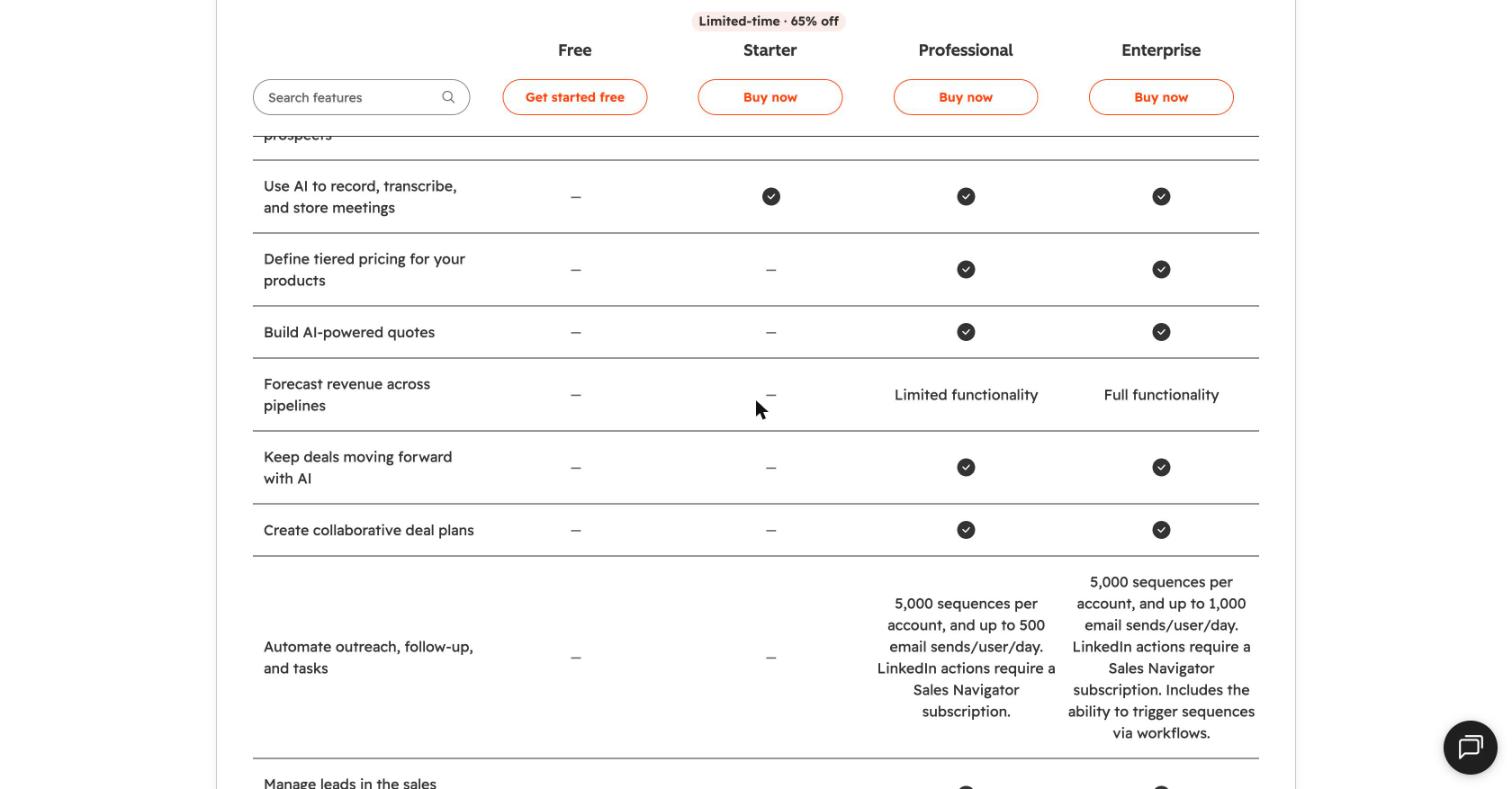
| HubSpot | HubSpot teams | AI projections from closed-won deals | Beta; needs Professional or Enterprise; onboarding required, fee not stated | Professional $90 a seat a month billed annually ($100 monthly) | Free tier has no forecasting |
| Microsoft Dynamics 365 Sales | Dynamics teams | Predictive forecasting | Needs a premium forecasting licence | Premium licence, see Microsoft | None listed |
| Pipedrive | Pipedrive teams | Forecast reports using probabilities people set | No AI forecasting on its pricing page | Growth from $39 | 14-day trial |
| Forecastio | HubSpot teams | A forecasting layer on HubSpot data | HubSpot only | $249 a month including 2 seats | One-month pilot |
HubSpot gates forecasting by plan.
Among sales forecasting tools with public prices, 10 seats cost these monthly amounts (our calculation). Pipedrive Growth is $390, Salesforce Pro Suite $1,000 and HubSpot Professional $900 billed annually, with required onboarding.
Forecastio is $641 plus a HubSpot licence, as AI forecasting software built on HubSpot.
For AI sales forecasting tools free of charge, expect trials, not free plans.
prices are list prices from each vendor’s own pricing page as of November 2026, per seat per month, annual billing where stated. The 10-seat costs are our arithmetic.
How to Choose an AI Forecasting Tool
How to choose an AI solution for sales forecasting comes down to five checks, each with one question for the demo.
- CRM fit: ask which fields it reads. HubSpot’s forecast needs a deal date and a currency amount field.
- Explainability: ask it to show why one deal scored low.
- History needed: ask for the bar in months and closed deals.
- Forecast categories: ask whether it rolls up commit, best case and pipeline.
- Price: ask for a quote at your seat count.
Can ChatGPT or Excel Do AI Sales Forecasting?
ChatGPT and Excel can both produce a forecast number from a CRM export, but neither gives live per-deal scores that update as deals close.
ChatGPT’s data analysis makes no outbound network requests, and Excel’s FORECAST.ETS runs in desktop Excel only.
| Tool | What it can do | Where it stops | Move to a tool when |
|---|---|---|---|
| ChatGPT | Fits a trend or simple model to an uploaded export | Works on the file, not a live feed | You need weekly refresh or per-deal scores |
| Excel | FORECAST.ETS extends a period series with exponential smoothing | Cannot see deal-level fields; not in Excel for the web, iOS or Android | You need per-deal probabilities |
How to Use AI for Sales Forecasting in 5 Steps
- Measure your baseline error. Score your current method’s MAPE and bias over the last four quarters, as in the test above. Check: both numbers are written down.
- Clean the fields the model reads. Check: Amount is filled on at least 80% of open deals, Salesforce’s bar, and no open deal has a close date in the past.
- Pick the method from the readiness table. Check: you clear the data bar of the tool you pick.
- Pilot with one team, beside the current forecast. Log each manager override and its reason. Check: overrides are logged.
- Review overrides weekly and decide after two quarters. Decide upfront what the review replaces, since 72% of sales organizations reinvest little of the time AI saves. Check: both methods are scored on the same quarters.
Which Forecast Will You Trust Next Quarter?
Your closed-deal count decides whether AI for sales forecasting is worth testing, and a two-quarter run beside your current method decides whether to switch. Which forecast does your leadership trust most today, and what would change that?
Frequently Asked Questions About AI Sales Forecasting
Are sales reps going to be replaced by AI?
No. AI moves the number to the model, but the call stays with the manager. A model cannot see what a rep holds in their head, such as a verbal buyer commitment never logged in the CRM. Reps who log activity well give the model better inputs, so forecasting work shifts toward reviewing scores and overrides.
Can you use AI to do your forecasting?
Yes, per deal, and only with closed-deal history to learn from. The model gives each open deal a win probability and rolls them up to a period. If data is insufficient, Dynamics 365 leaves the prediction column empty rather than guessing. Check the history bar of your CRM’s AI before relying on it, since each vendor sets its own.
Which AI tool is best for sales?
No tool wins for every team. Start from the CRM you already run: use its built-in AI before buying a standalone tool, because built-in options read your fields without a connector. A standalone tool earns its cost only when it covers a gap the built-in one leaves. A second CRM is one example.
How accurate is AI sales forecasting?
No independent benchmark exists that we can source. Aviso’s pricing page shows “98+%” with no stated measure, period or baseline, so treat such figures as marketing. For comparison, nearly half (52%) of sales leaders in Xactly’s 2024 survey said their forecasts were off by 10% or more. Test your own by scoring both methods on the same quarters.
How does AI sales forecasting connect to an existing CRM?
It connects in three links: the fields it reads, the stage mapping and the write-back of the number into the CRM. Test the stage mapping first: a model trained on “Qualified” cannot read your “Discovery done” stage without a mapping. Check this in a demo, and note that some tools, such as Forecastio, work with one CRM only.
Can AI forecasting work for a small sales team?
Yes, if the team closes enough deals; headcount is not the test. Salesforce’s bar for opportunity scoring is its own, not a rule, but it shows the scale. A team winning 6 deals a quarter would need 100 months to reach 200 won deals. Below that volume, a stage-weighted forecast you re-check each quarter is the honest choice.
Which industries benefit most from AI sales forecasting?
No recent study ranks industries, so any ranking you see is unsupported. The better guide is the kind of sales cycle. High-volume sales with short to mid cycles produce enough closed deals for a model to learn from. Long, low-volume enterprise cycles benefit least, because each model sees few outcomes. This is our judgment, not a measured result.
How does AI forecasting adapt to market changes?
A model learns from closed deals, so a shift shows up only after a lag set by its training window. The catch is recalibration: in a 2025 Clari Labs survey of 400 North American enterprise leaders, 39% recalibrate forecast models only weekly or monthly. Ask any vendor how often it retrains, and review overrides whenever your market or pricing moves.
How much does AI sales forecasting software cost?
Read a quote for what it includes, not only the headline price. Clari, Gong and Aviso publish no price, so ask what each tier adds. Look for onboarding, which HubSpot requires on Professional and Enterprise without stating a fee. Check seats included, such as Forecastio’s two, and add-on tiers, such as Gong’s Forecast tier above Forecast Essentials. Price a quote against your own seat count.